Overnight train travel in Vietnam provides a unique way to traverse the country, allowing passengers to cover long distances while resting. These journeys offer a perspective on local life and diverse scenery, proving both an efficient and memorable component of any travel itinerary.
Understanding the different seating and sleeping accommodations, along with reliable booking procedures, can significantly enhance your experience. This guide outlines everything necessary for planning your rail adventure, from selecting the right ticket class to securing your reservation.
Exploring Vietnam's Railway System
Vietnam's rail network is more than just a transportation artery; it serves as a moving observation deck into daily Vietnamese existence. The steady rhythm of the wheels often creates a calming environment for rest, and each mile reveals new aspects of the nation's diverse geography.
Choosing a sleeper train in Vietnam combines travel with lodging, offering a cost-effective and practical solution for covering considerable distances. Compared to bus alternatives, trains generally provide greater personal space and a smoother, quieter ride. When contrasted with air travel, trains are typically more economical and allow for an intimate, ground-level appreciation of Vietnam's scenery. Furthermore, the gentle motion of the train and the consistent track sounds can contribute to a surprisingly refreshing night's sleep.
Prominent Overnight Rail Connections in Vietnam
The renowned Reunification Express forms the backbone of Vietnam's rail infrastructure, linking the northern and southern regions along the coastline. Key overnight routes frequently chosen by travelers include:
- Hanoi to Sapa (Lao Cai) – The Highland Expedition: This trip typically lasts 7 to 8 hours, departing in the late evening (around 21:00-22:00) from Hanoi and arriving in Lao Cai by early morning (05:00-06:00). The route showcases mountain vistas, misty valleys, and terraced rice fields, making it an ideal approach to Vietnam's northern highlands. For those considering other modes of transport to this region, various options exist for traveling from Hanoi to Sapa.
- Hanoi to Da Nang/Hue – The Central Coast Passage: Journeys range from 12 to 18 hours, depending on the specific destination. Multiple trains operate throughout the day and night, offering flexible scheduling. The section between Hue and Da Nang is particularly celebrated for its coastal views.
- Ho Chi Minh City to Nha Trang – The Coastal Classic: This overnight journey usually takes 7 to 9 hours. Several trains run daily, with departures from early morning to late night. Passengers can expect views of coastal plains and sunrises over the South Central coast, appealing to those heading to the beaches.
- Ho Chi Minh City to Phan Thiet/Mui Ne – The Beach Express: A shorter trip, lasting 4 to 5 hours, with both daytime and nighttime services available. The scenery along this route includes sandy beaches and more arid landscapes, leading to relaxed seaside communities.
Understanding Overnight Train Ticket Classes
Familiarizing yourself with the various seating and cabin options helps in selecting the most appropriate choice for your specific travel needs. Below are the common ticket categories available on Vietnam's sleeper trains, along with their characteristics and suitability for different types of passengers.
| Route | Hard Seat | Soft Seat | 6-Berth Cabin | 4-Berth Cabin | 2-Berth VIP Cabin |
|---|---|---|---|---|---|
| Hanoi → Sapa (Lao Cai) | From VND 125,000 (~USD 5) | From VND 155,000 (~USD 6.2) | N/A | From VND 690,000 (~USD 27.6) | From VND 1,300,000 (~USD 52) |
| Hanoi → Da Nang/Hue | From VND 380,000 (~USD 15.2) | From VND 560,000 (~USD 22.4) | From VND 642,000 (~USD 25.7) | From VND 875,000 (~USD 35) | From VND 2,077,000 (~USD 83.1) |
| Ho Chi Minh City → Nha Trang | From VND 200,000 (~USD 8) | From VND 280,000 (~USD 11.2) | From VND 358,000 (~USD 14.3) | From VND 450,000 (~USD 18) | From VND 1,400,000 (~USD 56) |
| Ho Chi Minh City → Phan Thiet | N/A | From VND 121,000 (~USD 4.8) | From VND 245,000 (~USD 9.8) | From VND 250,000 (~USD 10) | N/A |
Hard Seat
The hard seat option is the most fundamental and economical choice on Vietnamese overnight trains, featuring wooden benches designed to accommodate 2-3 passengers. While not ideal for extended travel, this class remains a frequent selection for budget-conscious travelers on shorter distances.
Its advantages include affordability, the availability of window seats for viewing, and a face-to-face seating arrangement that can encourage interaction. Storage for luggage is provided above and beneath the benches. However, these seats lack cushioning, can become noisy and crowded, offer limited recline, and are not suitable for overnight journeys. This option is best for travelers on a tight budget taking short daytime trips, typically under four hours, such as from Hanoi to Ninh Binh.
Soft Seat
Soft seats on Vietnam's overnight trains are basic upholstered chairs with minimal reclining capability. Though they do not feature amenities like tray tables or generous legroom found in some other transport, they provide a greater degree of comfort than hard seats. These carriages are usually air-conditioned, making them a suitable and reasonably priced option for daytime travel on short to medium-length routes.
Benefits include air-conditioned environments, sufficient padding for mid-distance travel, a two-seat configuration on each side, and overhead luggage storage. Facilities are generally clean. Nevertheless, they are still just seats, not designed for sleeping, have limited legroom compared to sleeper options, and can become uncomfortable on journeys exceeding six hours. This class is best suited for travelers who prefer daytime journeys with more comfort than basic seating. Prices typically range from VND 121,000 (~USD 4.8) for shorter trips to VND 560,000 (~USD 22.4) for longer routes like Hanoi to Hue.
6-Berth Compartment
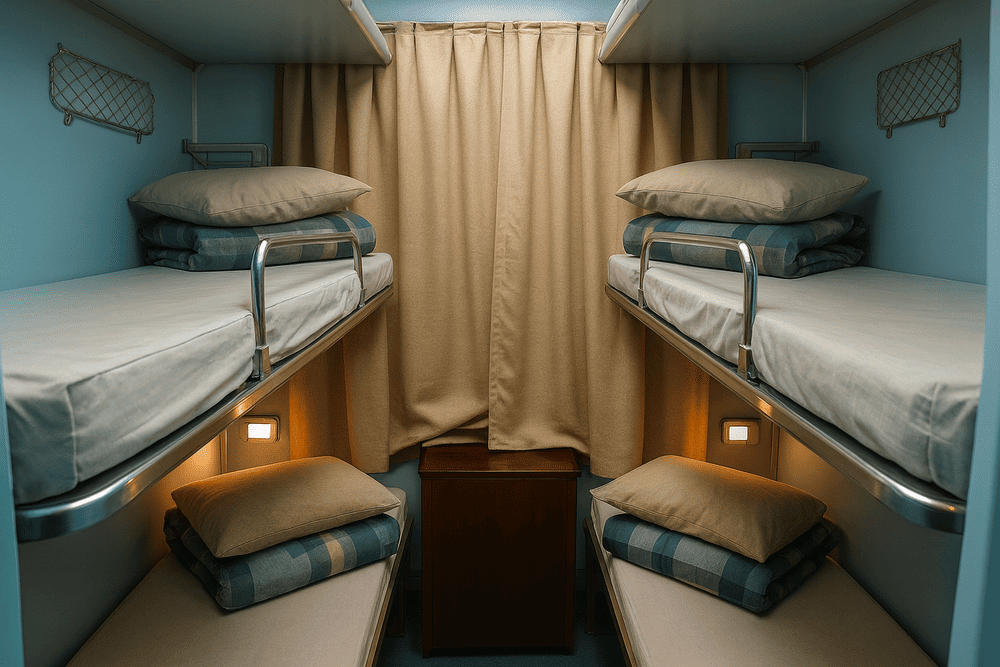
The 6-berth compartment offers a more economical sleeping arrangement on Vietnamese trains, featuring actual beds arranged as triple bunks (upper, middle, and lower) on each side. Each compartment is equipped with a door, window, curtain, night lamp, and a small table.
These compartments provide real beds with thin mattresses, pillows, and blankets, making them the most affordable sleeping choice. They also foster social interaction among passengers. The middle bunk is often considered best for sleeping, while the lower bunk offers better comfort during the day with window access. Downsides include limited headroom, which might be a concern for some, and sharing space with five other individuals, potentially leading to noise. This option is recommended for travelers on a budget or those undertaking shorter overnight trips. Prices range from VND 245,000 (~USD 9.8) for shorter routes to VND 642,000 (~USD 25.7) for longer journeys like Hanoi to Hue.
4-Berth Compartment
A popular choice for many travelers, the 4-berth compartment includes two upper and two lower beds, featuring thicker mattresses, individual reading lights, and small tables with charging outlets. These compartments offer enhanced comfort and privacy with only four occupants.
Advantages include superior bedding quality, increased personal space, power outlets for devices, lockable doors for security, individual reading lights, and improved ventilation. The primary disadvantage is a higher cost compared to the 6-berth option, and sharing the space with others unless the entire compartment is reserved. This class is ideal for most travelers seeking a balance of comfort and value, including families and couples. Prices vary from VND 250,000 (~USD 10) on shorter routes to VND 875,000 (~USD 35) for extended journeys.
2-Berth VIP Cabin Bed
Representing the most premium option on Vietnamese sleeper trains, the 2-berth VIP cabin features only two lower beds within a private compartment. These cabins often include soft bedding, provided meals, bottled water, snacks, tissues, and even mugs.
Key benefits are maximum privacy for two passengers, premium bedding and amenities such as complimentary snacks, drinks, tissues, and fruit, with meals included in the fare. They offer a quiet and comfortable setting for uninterrupted rest. However, availability is extremely limited, the cost is approximately double that of a standard 4-berth soft sleeper, and these cabins are not available on all routes or train schedules. Securing a VIP cabin during peak travel seasons often requires early booking. This option is best suited for luxury travelers, honeymooners, or anyone prioritizing maximum privacy. Fares typically start from VND 1,000,000 (~USD 40) for shorter trips and can reach VND 2,077,000 (~USD 83.1) for the Hanoi to Hue route. For those interested in other premium rail experiences, Vietnam also offers specialized luxury train services.
Securing Your Overnight Train Tickets in Vietnam
Booking rail tickets in Vietnam has evolved considerably, now providing both traditional and contemporary methods to accommodate varying traveler preferences and technical proficiencies.
Online Booking Procedures
Online reservation systems allow you to review numerous train choices, compare prices, and select your preferred ticket class from any location. To book online, travelers can visit the official Vietnam Railways website (dsvn.vn), utilize the mobile application “Duong Sat Viet Nam,” or access third-party platforms like Baolau or 12Go Asia. After choosing your departure and arrival points, date, and passenger count, you can select a train and ticket class. Passenger details are then entered, followed by payment via credit or debit card. An e-ticket or QR code will be sent to your email for presentation upon boarding. It is advisable to book 2-3 days in advance for common routes, and at least a week ahead for VIP or sleeper cabins, especially during holiday periods.
Purchasing Tickets at Train Stations
This traditional method is suitable for travelers who prefer spontaneous plans, wish to pay with cash, or are less comfortable with online platforms. Engaging directly with ticket agents in person can also simplify the process of clarifying options, asking questions, or requesting specific berths. To purchase tickets at a station, visit the nearest railway station, such as Hanoi Railway Station or Saigon Station. Proceed to the ticket counter, where signage is often bilingual. Provide your route, travel date, ticket class, and the number of passengers. A passport may be requested for identification. Payment can be made by cash or card, and a printed ticket will be issued. It is recommended to arrive 30-60 minutes before departure for boarding. Visiting the station during off-peak hours, such as mid-morning or mid-afternoon, can help avoid long queues. While solo travelers often find tickets available close to departure, families should book in advance.
Important Considerations for Overnight Sleeper Train Travel
Being aware of these practical aspects ensures your train journey aligns with your expectations and helps in avoiding common travel challenges.
Baggage and Storage
Although Vietnamese trains do not impose strict weight limits for luggage, space can be restricted, particularly within sleeper cabins. Large suitcases or backpacks can typically be stowed beneath the lower berths or on the overhead racks provided in each compartment.
Dining and Refreshments
Food availability varies depending on the specific train and ticket class. Some sleeper tickets may include basic meals or snacks, while others, especially VIP cabins, might offer complimentary water, tea, or light refreshments. Passengers may also encounter local vendors selling items like bánh mì, rice dishes, or beverages at various stops along the route, presenting an opportunity to sample regional cuisine. Those interested in local food experiences might also enjoy exploring essential Vietnamese dishes.
Safety and Hygiene Standards
Vietnam’s rail network is generally considered secure, particularly within air-conditioned soft sleeper and VIP cabins, where security measures are typically more stringent and fellow passengers are often other tourists or families. However, cleanliness levels can differ between trains and may decline on longer routes. Restroom facilities are functional but can become less tidy as the journey progresses, particularly on older trains. For enhanced comfort, it is advisable to bring personal toilet paper, wet wipes, and hand sanitizer.
Booking Recommendations
It is prudent to book your train tickets well in advance, ideally a week or more ahead for VIP or soft sleeper cabins. Utilize the official Vietnam Railways website (dsvn.vn) or reputable third-party agents such as Baolau or 12Go Asia. If your travel plans include luxury trains like the Victoria Express or Livitrans, check their respective official websites for direct promotions, bundled packages, or upgraded cabin options. Booking early is especially crucial during peak travel periods, including the Tet holiday, other Vietnamese national holidays, and the summer months.
Frequently Asked Questions
Do Overnight Trains Have Beds?
Yes, the majority of overnight trains in Vietnam offer sleeper accommodations with beds, typically measuring 31 x 75 inches each. Depending on the ticket class purchased, options include 6-berth, 4-berth, or 2-berth VIP cabins. Each sleeping space comes with a mattress, pillow, and blanket, allowing passengers to lie down and rest. However, if you book a hard or soft seat, you will only have a reclining seat and no bed access.
Are There Toilets on Vietnam's Overnight Trains?
Indeed, overnight trains in Vietnam are equipped with toilets, though their condition varies significantly by train type and class. Newer trains, such as those in the SE series, and private operators like Livitrans Express, generally provide cleaner, more contemporary facilities with Western-style toilets. First-class and VIP cabins typically offer better restroom conditions than standard sleeper cars. It is always recommended to carry your own toilet paper and hand sanitizer, regardless of the train chosen.
Can Passengers Purchase Food on Vietnamese Trains?
Certain sleeper tickets include complimentary meals or light snacks, especially in higher-tier cabins like the 2-berth VIP. Additionally, train staff or local vendors who board at major stations frequently sell food and drinks onboard. Available items often include rice boxes, instant noodles, soft drinks, and local snacks. However, selections might be limited, so travelers with specific dietary preferences or requirements may wish to bring their own food and bottled water.
Do Overnight Trains Offer Shower Facilities?
No, Vietnam's overnight trains do not include shower facilities. This is a common standard for most overnight train systems globally. For extended routes, such as Hanoi to Da Nang or Ho Chi Minh City to Nha Trang, it is best to plan for a shower either before boarding or upon arrival at your destination.